


As the cool, crisp air of autumn gives way to the biting chill of winter, it’s time to start thinking about how you’ll tackle the inevitable snowfall. For many homeowners, a reliable snow blower is an essential tool for keeping driveways, sidewalks, and pathways clear and safe. But with so many options in the market, it can be challenging to know which type of snow blower is right for your needs.
If you’re thinking about buying a snow blower for the first time, you probably have a lot of questions. Foremost on your mind: What’s the difference between a 1-, 2- and 3-stage snow blower? Or what’s the difference between a snow blower and a snow thrower. You are not alone, these are probably the most frequently answered questions with regard to snow blowers.
There are many other facts that you should take into account before deciding which is going to be the best snow blower for your needs. The depth of the snow that you experience is going to play an important role. Wet snow also requires a snow blower that can contend with this, so you may want to know which type of snow blower is best for wet snow.
Is a gas, electric or battery-powered snow blower going to be your best option? You have your budget to consider, storage space for your snow blower and, perhaps, a whole lot of other stuff that you haven’t even thought of yet. There’s a lot to cover, so let’s get started so you can confidently handle whatever winter throws your way.
Types of Snow Blowers
There are basically three types of snow blowers to choose from.
A single-stage snow blower, which includes snow shovels, are the most basic and therefore the cheapest. Next up the list will be two-stage snow blowers, which are generally larger, more powerful and usually more expensive than single-stage snow blowers.
Finally, the biggest of all the snow blower types is the three-stage snow blower. These type of snow blowers aren’t the most common, they’re usually used for commercial and municipal purposes. We’re going to focus mainly on the first two types – single-stage vs two-stage snow blowers.
Single-Stage Snow Blowers
Let’s start by answering the question: what’s the difference between a snow blower and a snow thrower. A single-stage snow blower is actually a snow thrower. Although many people refer to snow throwers as snow blowers, there is a difference. The name says it all.
All snow blowers / throwers use an auger to remove snow and ice from the ground. A single-stage snow blower also uses the auger to expel the ice and snow through a chute. So it doesn’t actually blow the snow away, the snow is thrown by the rotating auger.
This has a two-fold effect on how you use a single-stage snow blower, or more correctly, a snow thrower. Because the auger has to lift the snow from the surface and fling (or throw) it a reasonable distance away from the machine, the auger design must strike a balance between these two functions, which leads to a slight trade-off in overall performance.
It won’t remove as much snow, nor will it cut as deep into the snow. It also won’t throw the snow as far from the snow blower. For these reasons, single-stage snow blowers aren’t suitable for heavy, wet snow or for clearing larger areas, like long driveways. Typically, you can expect a single-stage snow blower to handle up to around 6 – 8 inches of snow.
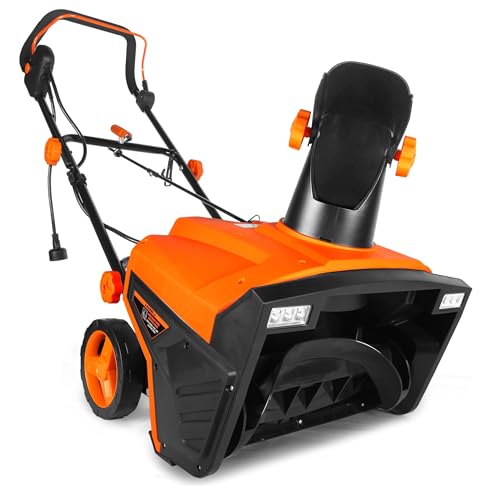


Westinghouse WSnow18 (2 Batteries / Charger Included) / 18 inch

Another factor that may affect your decision, if you’re looking at a single-stage snow blower, is that the auger makes direct contact with the ground. This means they are very effective at clearing paved areas down to the surface. A single-stage snow blower won’t leave a layer of ice or snow behind. However, they are not the best in clearing a gravel surface, or any ground that has loose debris.
While the auger offers some assistance to the user, in moving the machine forward, a single-stage snow blower doesn’t really have much power assistance. These machines will move slower than the other types and don’t fare well on an incline.
There are benefits to using a single-stage snow blower, if you don’t need anything too big and powerful. First of all, it is the cheapest option. You may see an overlap in the pricing. So some of the larger, high-end single-stage snow blowers could cost more than entry level 2-stage machines. Though the cheapest machines will always be single-stage.
Single-stage snow blowers (especially the smaller models) are lighter and more compact than 2-stage (or 3-stage) models. This makes them easier to move around the yard and they need less storage space.
Two-Stage Snow Blowers
The main difference between a single-stage and two-stage snow blower, is about how the snow is expelled from the chute. Instead of using the auger to throw the snow, a two-stage snow blower has a powerful impeller that forces the snow and ice upward, out of the auger and into the chute. So the snow is literally blown away from the machine.
This dual, 2-stage action has a number of benefits. The forced air blowing action allows it to discharge larger volumes of snow and ice, and deposit them farther away. Probably more beneficial is the auger action which is much more effective at removing larger volumes of ice and snow. It is also more competent in compact snow and ice.
If you experience frequent snow storms, with snow and ice deeper than 8″, you probably need a two-stage snow blower. They can handle a depth ranging from around 20-inches, right up to 45-inches for really large gas-powered machines.
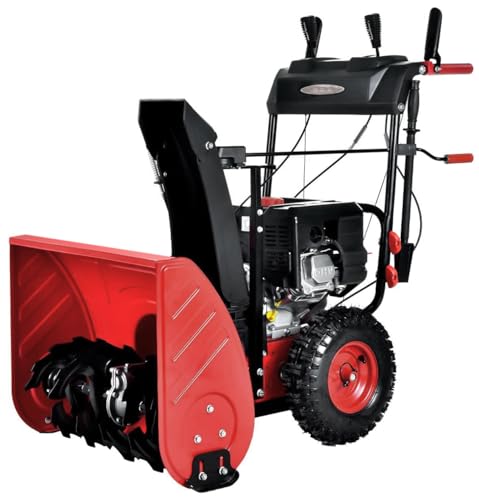



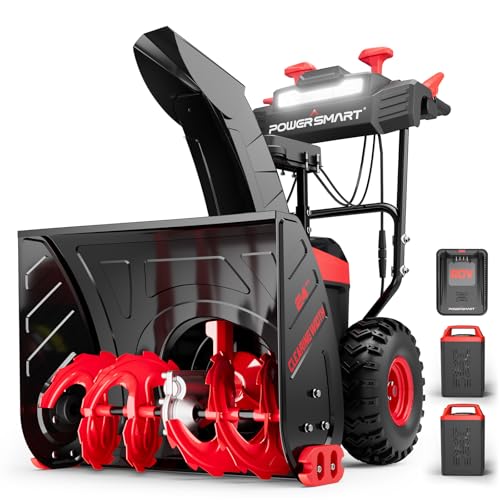

There are a few other areas where two-stage machines are more advantageous. Two-stage snow blowers have power assistance. This can be achieved by driving the wheels or an auger that propels it forward with enough power to negotiate a reasonable incline. If you have slopes in your yard that need clearing, we’d strongly suggest a 2-stage snow blower.
Unlike single-stage snow blowers, two-stage augers don’t make contact with the surface. This means that they can be used on irregular ground with gravel and debris. Of course, this means that the auger leaves a thin layer of snow or ice. For most models, this isn’t an issue, because they can have scrapers that remove the layer left by the auger.
For their many advantages, two-stage snow blowers do have their pitfalls. They are going to cost more than most single-stage machines. And they are relatively large, heavy machines, so they’re not as convenient to store. They may also be less easy to maneuver around the yard, requiring a greater turning circle than a single-stage snow blower.
Three-Stage Snow Blowers
Three-stage snow blowers are designed to handle the toughest winter conditions and are typically used in areas with heavy snowfall or in commercial settings. Homeowners with a particularly big property to clear may opt for one of these machines. A 3-stage snow blower makes clearing large volumes of snow and ice much quicker. This is because they use an additional accelerator auger.
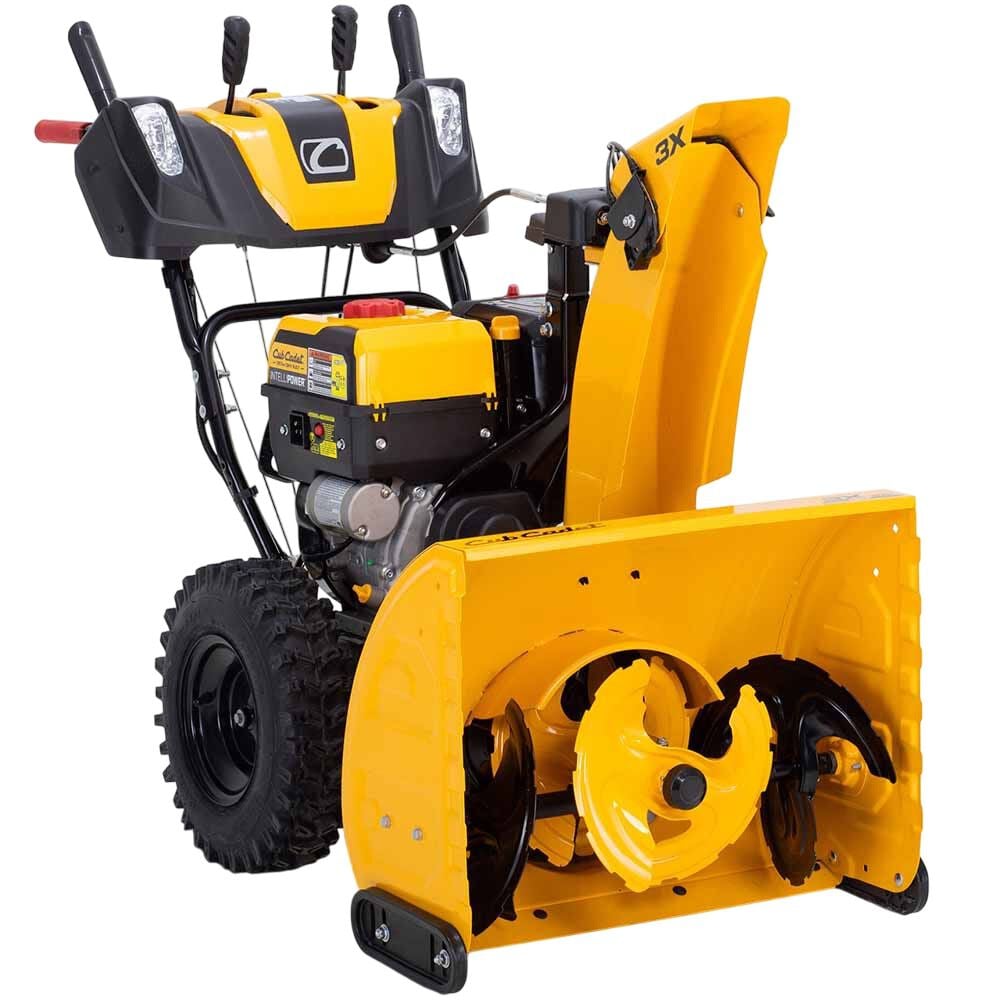

They can be a fair bit larger than two-stage machines, but their main advantage is being able to work much faster. A 3-stage snow blower with the same clearing capacity as a larger 2-stage machine will accomplish a lot more in a shorter space of time. Three-stage snow blowers are the most expensive of the lot.
Corded vs Cordless
Understanding the differences between single-stage, two-stage, and three-stage snow blowers is a crucial first step in selecting the right machine for your needs. However, the number of stages is not the only factor to consider when making your decision.
Another essential aspect to evaluate is the power source. Snow blowers can be powered by electricity – corded or cordless – or by gasoline. Each power source has its own unique benefits and drawbacks that can greatly influence the snow blower’s performance, ease of use, and overall user experience. Let’s briefly address the different power source options.
Corded Electric Snow Blowers
The cheapest snow blowers will always be single-stage corded electric machines. You should be able to find a good quality single-stage electric snow blower for a little over a hundred dollars.


It’s important that you realize what you’re buying. Snow blowers in this price range, are going to be light to medium-duty machines. Expect to pay about double this for the same type of quality when buying a 2-stage machine.
However, while the upfront cost of a corded electric snow blower may be lower than other options, it’s essential to keep in mind that you’ll need a reliable, weather-resistant extension cord to power your machine, which can add to the overall cost of your setup.
In addition, the cord can restrict your range of movement and requires careful management to avoid tangling or damaging the cord. Despite this limitation, corded electric snow blowers remain an affordable and efficient option for those living in regions that don’t experience heavy snowfall throughout most of the winter and have smaller areas to clear with easy access to a power outlet.
Battery-Powered Snow Blowers
Battery-powered snow blowers have gained popularity in recent years due to their cordless convenience and improved performance. These machines are powered by rechargeable lithium-ion batteries, allowing you to clear snow without being tethered to an electrical outlet. This makes them ideal for larger properties or areas where access to power outlets may be limited.
Westinghouse WSnow18 (2 Batteries / Charger Included) / 18 inch

EGO Power+ SNT2134 (2 Batteries / Charger Included) / 21 Inch
When considering the purchase of a battery snow blower, it’s important to factor in the additional cost of the battery and charger kit. These essential components can significantly increase the overall expense compared to a corded electric equivalent. In many cases, you could end up paying more than double for the battery-powered option.
If you live in a region with heavy snowfall, clearing snow may take longer, and a single battery may not provide enough runtime to complete the task. If you find that your snow blower’s battery runtime is insufficient for your needs and want to avoid interruptions during your snow-clearing sessions, investing in one or more spare batteries can be helpful, further adding to the overall expense of owning a battery-powered snow blower.
If the cost of additional batteries is prohibitive, you may need to plan your snow-clearing sessions around the available battery runtime focusing on clearing important areas first, or consider a corded electric or gas model instead.
Gas-Powered Snow Blowers
If electric and battery snow blowers don’t make the grade in terms of power or size, gas is going to be your best option, particularly for large properties or areas with heavy snowfall.
When looking at gas-powered equipment, of any kind, the concept of cheap should be the last thing on your mind. Cheap gas engines are a nightmare. Remember that a gas-powered snow blower has many more mechanical parts. This means there’s more to go wrong and you need to pay attention to your maintenance requirements.
After giving the matter all due consideration, you find that a gas snow blower is your best choice, be prepared to pay for it. Here brand becomes very important. Not only are unknown, cheap brands unreliable and problematic, it’s often impossible to find spare parts for these machines. You’re already paying considerably more for a gas snow blower than you would for any electric machine. So trying to save fifty, or even a hundred bucks on a gas snow blower could easily come back to haunt you.
A quality gas machine, from a reputable brand, is going to provide you with many years of reliable service (possibly a lifetime). A gas engine can be repaired almost indefinitely. You want a brand that is going to provide you with the service (and spares) that you require over the lifetime of the machine. Once you’re spending this kind of money, you don’t want to be doing it again in a hurry. So it’s important to make sure you get right first time around. Hence our opinion that cheap gas-powered machines are simply not worth considering.
Final Thoughts
When reading customer reviews, we find that so many complaints are from people buying a product that doesn’t meet their expectations. If you’re buying a cheaper, light-duty snow blower and expect it to do the job of an expensive, heavy-duty machine, you’ll end up sorely disappointed.
Without wasting your money on something that exceeds your needs, you need to ensure that the snow blower you’re buying is going to be up to the job that you intend doing with it. By now, you should have a pretty good idea of the various types of snow blowers and how they work.
To wrap things up, single-stage snow blowers are intended for light snow up to about 8-inches. For heavier snow and, more importantly, wet snow and ice, a two-stage snow blower is the best, the largest of these can handle snow drifts up to 45-inches.
Of course, this would also include 3-stage snow blowers as they are the most capable all around. Though, for most home owners, a powerful 2-stage snow blower should be more than adequate for wet snow and ice.

