


As times change, so do the preferences and regulations surrounding outdoor power equipment. With increasing concerns about environmental impact and noise pollution, many cities and states have begun implementing bans and restrictions on the use of gas-powered tools.
California has already banned their sale, and many cities and counties across the US have prohibited their use. As a result, homeowners and professionals are pushed to seek out cleaner and quieter alternatives that can provide similar performance without the negative environmental impact. Enter electric-powered tools.
Why Electric-Powered?
Cordless
Advancements in lithium-ion battery technology have significantly improved the performance and runtime of battery-powered tools, making them a viable and environmentally friendly alternative.
They provide numerous advantages. First and foremost they don’t burn fuel, release noxious exhaust, or harm the environment. They also boast lower sound power levels, reducing the likelihood of neighborhood complaints and creating a more pleasant working environment.
They require less maintenance as well, thanks to the absence of spark plugs, carburetors, and other components that need regular upkeep. This translates to fewer potential problems and repair requirements, ensuring a more reliable and long-lasting tool.
In terms of convenience, battery-powered tools are easier to start, often with just a single button press, eliminating the need for pull-starts or other complicated starting procedures. Furthermore, some high-end battery tools can run just as long on full power as a gas model, if not longer, providing you with the runtime you need to tackle even the most demanding tasks.
That doesn’t mean they are perfect, though.
Sometimes, the battery/charger kit costs more than the actual tool. In addition, batteries will eventually wear down and lose their capacity to hold a full charge over time. Depending on the frequency and intensity of use, you may need to replace the batteries sooner than expected. And if you require extended runtime, investing in spare batteries becomes necessary to ensure uninterrupted work, adding to the overall cost of ownership.
On the other hand, consider the long-term cost savings. Unlike gas models, battery tools don’t require regular fuel purchases, which can add up significantly over time. Also, many cities and counties offer discounts or incentives for switching to zero-emission garden equipment. So be sure to check out if there are any local government incentive programs – like California’s Zero-Emission Landscaping Equipment Incentive Program for example – that encourage the use of eco-friendly tools. This can help offset the initial investment.
Corded
You may also be tempted to go for an electric corded tool, but it comes with the limitation of always needing to be plugged in during use. Ultimately, the convenience and mobility offered by battery-powered equipment often outweigh the potential cost savings of using a corded tool, particularly when it comes to tackling hard-to-reach areas on your property.
But for those with smaller spaces to maintain such as a tiny yard, patio, or deck, the limited mobility may not be a significant issue, and the cost savings on batteries or fuel could make it a more attractive option. Additionally, electric corded tools are often lighter, which can be an advantage for users who prioritize a lighter tool for smaller tasks.
What Makes a Powerful Leaf Blower?
For leaf blowers, power is mainly about three factors: air volume, air speed, and blowing force. Here’s a quick rundown of what each of these mean:
- Air Volume (measured in cubic feet per minute/CFM) is how much air the blower actually moves — a higher CFM means a blower can move more debris with each pass.
- Air Speed (measured in miles per hour/MPH) is how fast the air comes out of the nozzle. The higher the MPH, the more quickly and effectively it can move debris across farther distances with each pass.
- Blowing Force (measured in Newtons/N) represents the overall power and intensity of the airstream. A higher Newton rating generates a stronger and more intense airflow, making it better suited for tackling tougher jobs.
By understanding the importance of these three factors and how they work together, you can select the best leaf blower for your specific needs.
Husqvarna’s Most Powerful Battery Leaf Blowers
When it comes to garden equipment, Husqvarna is widely recognized for their exceptional gas-powered equipment. However, that doesn’t mean their battery tools are anything to sneeze at, as their most powerful battery leaf blowers can still give you 20+ Newtons of pure force.
Husqvarna currently stocks six battery-powered blowers, any of which would be a great add to your landscaping arsenal. That said, to get something close to the performance of a gas model, you need nothing less than a top-tier battery tool. That’s why, for the purpose of this article, we’ll be focusing on the Husqvarna battery leaf blowers that boast the highest Newton rating.



These models are designed to generate the most powerful and forceful airstreams, making them the perfect choice for tackling heavy, wet leaves, soggy grass clippings, waterlogged mulch or debris that’s firmly stuck to the ground or clumped together. Here’s a quick comparison before we really get into the nitty-gritty of how each one of these leaf blowers holds up.
| Model | Air Velocity | Air Volume | Blowing Force | Weight (excl. battery) |
|---|---|---|---|---|
| 230iB | 136 MPH | 650 CFM | 19.6 N | 5.5 lbs |
| 350iB | 200 MPH | 800 CFM | 23.5 N | 6.2 lbs |
| 550iBTX | 148 MPH | 550 CFM | 21 N | 13.9 lbs |
Just to put things in perspective, Husqvarna’s gas models start at a modest 12.5 Newtons and go all the way up to an astounding 56 Newtons of blowing force, with the latter primarily commercial and industrial models that need this much power. And even then, they probably spend most of their time at a lower setting.
This puts the battery-powered blowers we’ll discuss, like the 350iB with its respectable 23.5 Newtons, in context. While this may seem low compared to Husqvarna’s top-end gas models, for the vast majority of residential applications, a blower in the 20-25 Newton range is more than adequate to handle your typical yard cleanup tasks with ease.
Husqvarna 230iB Handheld Blower
The Husqvarna 230iB is definitely the cheapest unit we’ll be talking about today, but even a “budget” tool from Husqvarna offers plenty of exciting features. For the price, it might be one of the most powerful handheld units you can get.

Equipped with a round nozzle, the 230iB delivers a maximum blowing force of 19.6 N. The boost mode feature allows you to increase the air flow and speed when needed, with a maximum air flow of 650 CFM and a top air speed of 136 MPH at the nozzle.
A premium control pad makes it easy to start and stop the tool and control the different speed options. The handy LED power indicator provides real-time information about the blower’s battery status, allowing you to monitor your remaining runtime at a glance.
The 230iB is designed with user comfort in mind. The bare tool weighs just 5.5 lbs, making it lightweight and easy to maneuver. The low noise and vibration levels, allow you to work comfortably for longer periods and the ergonomic, balanced design reduces strain on your arms, shoulders, and back. With the debris scraper you can easily move sticky, wet debris, further enhancing the blower’s versatility.
Husqvarna offers three compatible 40V lithium-ion batteries for the 230iB blower: the BLi22 (4.2 Ah / 2.9 lbs), the BLi30 (7.5 Ah / 4.2 lbs), and the 40-B140 (4.0 Ah / 2.6 lbs).


When paired with one of these batteries, the total weight of the leaf blower ranges from 8.1 lbs to 9.7 lbs, depending on the battery chosen. Husqvarna also offers two battery chargers for the 230iB compatible batteries: the QC250 and the 40-C80 charger. The QC250 charger offers a higher power output (250W), which translates to faster charging times, while the 40-C80 charger has a lower power output (80W), resulting in a slower charging process.

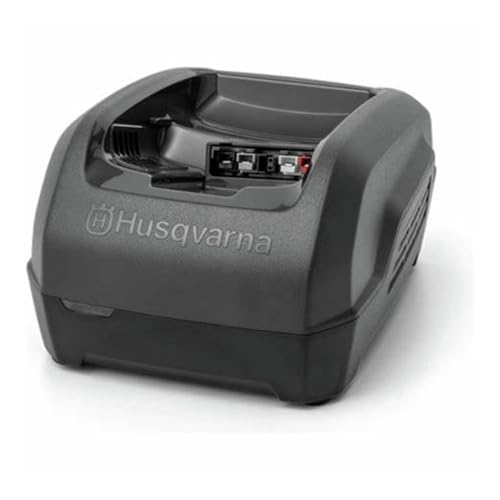
The 230iB can be purchased as a complete kit that includes the blower, 4.0 Ah battery (40-B140) and charger (40-C80). If you don’t already own Husqvarna battery-powered tools, or if your existing Husqvarna tools have batteries and chargers that are not compatible with the 230iB, the complete kit is the way to go.
If you already own other Husqvarna battery-powered tools that use any of the compatible batteries and chargers, you can save money by purchasing just the 230iB bare tool. It’s a great choice if you want to add the 230iB to your existing Husqvarna tool collection without spending extra on accessories you don’t need.


Overall, the Husqvarna 230iB offers a balanced combination of power, efficiency, and user comfort, making it an excellent choice for those seeking a reliable and eco-friendly solution for their leaf-blowing needs.
Husqvarna 350iB Handheld Blower
Voted the most powerful cordless blower of 2024 by Forbes, Husqvarna’s Leaf Blaster 350iB is perhaps (at this moment) one of the industry’s best handheld battery leaf blowers. This makes it the perfect choice for those who demand only the very best in performance.

The 350iB shares many of the same features and benefits as the 230iB, demonstrating Husqvarna’s commitment to provide a consistent and user-friendly experience across all their tools.
230iB vs 350iB
Both leaf blowers are part of the same battery ecosystem, which means they can be used with the same set of approved batteries (40-B140, BLi22, and BLi30) and chargers (QC250 and 40-C80).
If you already own other Husqvarna tools that use these batteries, you can easily swap them out and use them with the 230iB or 350iB. This compatibility allows you to maintain a consistent battery ecosystem across your Husqvarna tools, saving you money and making it more convenient to keep your tools powered up and ready to go.
While the 350iB is slightly heavier than the 230iB (10.4 pounds vs. 9.7 pounds with a BLi30 battery), both blowers feature the same lightweight and balanced construction that reduces strain on your arms, shoulders, and back during extended use.
Similar to the 230iB, the Leaf Blaster features a control pad with an LED power indicator, adjustable speed settings, and cruise control options for user convenience. Additionally, it comes equipped with a tube featuring a round nozzle and a handy scraper tip, which proves useful in dislodging stubborn debris during operation.
The biggest difference between the two models lies in their power and performance. The Leaf Blaster 350iB boasts an impressive 800 CFM (vs 650 CFM) air flow, 200 MPH (vs 136 MPH) air speed, and a maximum blowing force of 23.5 N (vs 19.6 N).
This exceptional power output makes the Leaf Blaster a true standout in the industry, rivaling and even surpassing some of the most powerful gas-powered handheld blowers on the market today. This includes Husqvarna’s own gas-powered handheld blowers – with the 125B and 525BX, only delivering a maximum blowing force of up to 12.5 N and 15 N, respectively.
Another key difference between both models lies in the battery and charger that come included with each kit. When you purchase the 230iB as a kit, you’ll receive the standard 4.0 Ah 40-B140 battery and 40-C80 charger. In contrast, the 350iB kit includes the more powerful 7.5 Ah BLi30 battery and faster QC250 charger.
And like the 230iB, there’s also a bare tool purchase option. By purchasing the 350iB bare tool, you can save money by utilizing the batteries and chargers you already have on hand, rather than investing in new ones.

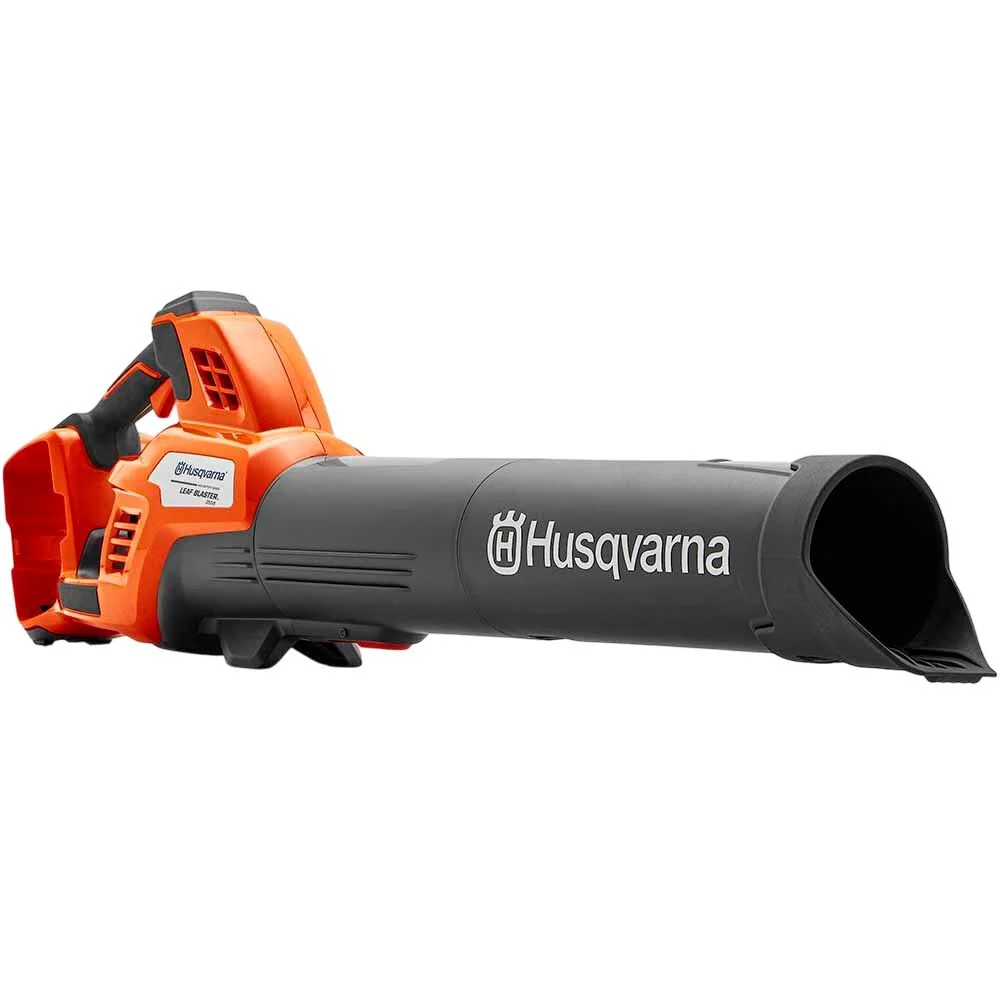
In conclusion, while the Husqvarna Leaf Blaster 350iB offers a significant step up in performance, the 350iB and 230iB have a lot in common. The choice between the two tools ultimately comes down to the level of power you require for your outdoor cleanup tasks.
Husqvarna 550iBTX Backpack Blower
With a maximum blow force of 21 Newtons, air flow of 550 CFM, and air speed of 148 MPH, the 550iBTX delivers similar ratings compared to the Husqvarna 230iB. However, the 550iBTX delivers all this performance in a comfortable backpack design.
The 550iBTX backpack blower comes complete with the highly durable BLi950X backpack battery and QC500 charger. With its impressive 31.1 Ah capacity the battery is engineered to provide the longest possible runtime in challenging professional settings, making it the ideal leaf blower for professionals who require a reliable and long-lasting power source.


The blower itself weighs 13.9 lbs, and the total weight when paired with the battery is 34.6 lbs. Despite the added weight of the battery, the 550iBTX remains well-balanced and comfortable to use thanks to the cleverly designed harness that effortlessly incorporates the backpack battery, which connects to the blower via a sturdy cable.
The 550iBTX has the power to tackle any task with its versatile airspeed settings, all easily managed through the intuitive handlebar keypad. You can choose between a continuous, steady airflow for regular cleaning or kick it up a notch with the boost mode when extra power is needed to move stubborn debris.
In addition to controlling the airspeed settings, the handlebar keypad also displays real-time battery power levels. This feature helps you better manage your time for the task ahead of you, ensuring you can complete the job without interruptions.
Unlike the 230iB and 350iB, the 550iBTX comes equipped with an integrated connectivity module that enables it to seamlessly sync with Husqvarna’s Fleet Services™ platform. By connecting to the platform, landscaping businesses gain access to a comprehensive suite of tools designed to help them track, manage, and optimize their equipment’s performance.
Which One to Choose? 230iB or 350iB or 550iBTX?
When it comes to choosing between the Husqvarna 230iB, 350iB, and 550iBTX, any of the units would be a great choice. Each one is a powerful, reliable, and efficient tool that can tackle a wide range of outdoor cleaning tasks with ease.
It’s essential to look beyond just the power ratings and price tags. While the Leaf Blaster 350iB boasts the highest CFM, MPH, and Newton ratings among the three, it may not always be the best fit for every situation.
The 350iB’s impressive performance ratings may be overkill for most residential applications, though it can be incredibly useful in cases where you’re dealing with expansive properties, dense foliage, or challenging terrains.
Furthermore, if you find yourself frequently tackling heavy-duty tasks or assisting with community clean-up projects, the 350iB’s high-powered performance can be a real time-saver.
On the other hand, the 230iB, with its more modest yet still excellent power ratings, is the best choice for most residential users. It strikes a balance between performance and affordability, making it a popular option for homeowners looking to maintain their properties efficiently without breaking the bank.
The 550iBTX, while slightly outperformed by the 350iB in terms of raw power, offers a different set of advantages. While the Husqvarna 550iBTX is primarily designed with professional landscapers and businesses in mind, it can still be an excellent choice for homeowners with extensive landscaping needs.
As a backpack blower, it provides greater comfort during prolonged use, and the high-capacity battery backpack ensures that users can work uninterrupted for extended periods without the need for frequent recharging.
Ultimately, you can’t boil this down to which leaf blower is the cheapest or the strongest. What matters is how you’ll plan to use it, and where. Think carefully about each of these units, the type and volume of debris you typically encounter and the actual pushing force you’ll need; this is the only way you can guarantee you make the right choice.

