


Multimeters – Who Needs them and Why?
If anyone asks me: “do I need a multimeter?”, my immediate response would be: “yes, of course, that should be a no-brainer“. Your next question would probably be why. You may also be wondering why these devices are so often referred to as DMM. This is a simple one to answer – DMM stands for digital multimeter, pretty self-explanatory. Because I’m a simple guy, I’ll mostly stick with the name I’ve always known which is, quite simply, a multimeter.
Since the days of analogue multimeters are relegated to the memory of old dogs, like me, defining a multimeter as digital is quite frankly a waste of words – all modern multimeters are digital. This means it has an LCD digital display and the measurements are calculated using transistors instead the old analogue (mostly MOSFET) technology that wasn’t always as accurate and certainly not as reliable and robust.
Well made electronic equipment, made using high-grade silicon, should last many decades. I have a Fluke multimeter that has been a faithful companion for more than 20 years and could well outlive me. I should add that this baby has worked more than most. I expect my tools to work as hard as I do.
Getting to Know the Electron Flow
Electricity is all around us and is becoming more important as we move away from archaic forms of energy like fossil fuels to more efficient, and sometimes cleaner, alternatives. Since the late 1800s, it has been a necessity to at least have a basic working knowledge of electricity and electric equipment. Over the last century and a bit, the marvel of electricity has transformed the world in ways that probably only Nikola Tesla was vaguely able to comprehend in those early days.
As much as we are accustomed to having electricity around us all the time, we are unavoidably aware of the deadly dangers presented by this magical alchemy that has become so commonplace. We take it entirely for granted. EVs add a whole new dimension to the story – but that would be the topic for another, very interesting, article.
While anyone can benefit from a more comprehensive understanding of electricity, which is pretty much the lifeblood of the modern world, not everyone needs the same level of understanding. When we’re comparing the myriad of multimeter options on sites like Amazon, we should gain some context to determine what our requirements are.
For use around the home, one would only need a simple device that can measure AC and DC current in various voltage ranges, resistance (ohms) and amperage are also standard features on most models and will come in handy.
A built-in capacitor tester is always a great advantage, but not so common on the cheap multimeters. For the novice, if you’re ever going to consider fixing, or at least diagnosing faults, on electric motors, you’ll need to measure stuff like capacitance and impendence. Words like that may seem a bit daunting at first. Once you own a multimeter, a good How-To guide will soon get you on top of things.
It’s great to get a basic idea of what’s wrong with your refrigerator, washing machine, or swimming pool pump before you call the pros to fix it. Who knows? You may even become proficient at basic electrical repairs, it isn’t that hard to understand. A multimeter will be your first and most important step toward acquiring the knowledge you’ll need to accomplish these tasks.
I should caution the uninitiated not to jump into the deep end when attempting high-voltage electrical repairs. By high-voltage I mean anything in excess of 50V (AC or DC). Since we’re about to delve into the wonders of the multimeter, I should start by offering a few explanations as to the hows and whys of electrical norms and regulations.
So, why do I mention 50V as something important? It’s all about electrical safety and the rules we are obliged, with good reason, to follow. Electrical regulations have evolved, mostly through learning the hard way, which is unfortunately how we humans tend to develop our understanding of things. It is a sad fact that many sustained pretty horrific injuries, some died, before authorities realized a need to institute rules for electrical wiring.
Setting 50V as the limit for a safe electrical voltage rating was one of the first moves in this direction. It is quite simple to understand – 50V or less is safe for humans and our pets to touch. As an example, we can look at 12V and 24V circuits in cars, trucks, and RVs. We can touch any exposed wire or connection at this voltage, without fear of electrocution.
While 50V is not too dangerous, unless you have a serious heart condition, it is at the bottom end of the dangerous voltage spectrum. This has become a standard rule that is accepted around the world. Any circuit operating at 50V or more must be completely insulated, preventing any contact between the conductor and the user of the appliance in order to minimize the risk of electrocution.
With the advent of the Ground Field Circuit Interrupter (GFCI), it is mandated by law to install an approved GFCI breaker to buildings in countries adhering to ISO regulations. This protects anyone using an electrical appliance.
As you learn to use your multimeter, you, a regular Joe homeowner, will be able to conduct basic safety tests to ensure that you and your family are safe. A simple hot to ground continuity test, performed once or twice a year, will provide you with the reassurance that there aren’t any nasty surprises awaiting you when you touch an appliance that may have damage insulation. A test like this is of particular importance for high-current water heaters and electric stoves.
The Journey to Becoming a Multimeter Master
I think I’ve made it abundantly clear that we can all benefit from owning a multimeter. However, when you start looking around for the best multimeter for your needs, things can become more than just a little bewildering.
There are so many options with prices ranging from what might appear ridiculously cheap to insanely expensive. The question of how much a multimeter may cost, cannot be answered with a simple sentence.
Generally, I am of the opinion that too cheap must be a bit nasty – so I tend to gravitate toward mid-priced brands that I know, up to some of the really expensive stuff, depending on how important it is to me. Tools that are used professionally need to be more robust, and usually more advanced than something we use occasionally for our hobbies and DIY home repairs.
Before I digress too far into the wonders of the multimeter, let me get to the point of this rambling narrative. This is not a review or even much of a multimeter buying guide. I intend to introduce you to multimeters if you’re not a pro. For those with a better understanding of electrical measuring equipment, I may be able to provide some deeper understanding of these pretty intricate devices.
There are some amazing products out there, developed specifically for intrepid electrical engineers. Only a few graduate to that level of sophistication, so I’ll take baby steps in guiding you along my path from my first multimeter to the present day.
My story should be a good way to go through the steps from novice to master of the humble multimeter. As I started out as a lighting technician way back when, then, several decades later, found myself as CEO of a pretty cool electrical engineering company, my story may provide some valuable insight.
I think my experience in this field and tracking it from that very first el’ cheapo DMM to the pretty sophisticated Fluke models that followed over the years, can serve as a wonderful guide toward understanding what it is you’ll be looking for when considering how to approach the purchase of a good quality multimeter.
I am biased toward Fluke when it comes to multimeters, just as I am toward DEWALT power tools. My opinions may be well-informed but they are not the holy grail of tool knowledge. There are many, more learned than myself, who may disagree with my opinions. An important caveat should be inserted here, to justify my approach.
Fluke is my personal favorite. This does not necessarily mean it is the best. Distinguishing the best of any type of product will always be a subjective thing. It has been the topic of arguments between artisans and the like in pubs, bars, and taverns the world over. So, I won’t be engaging the topic any further here. Suffice to say – you can’t really go wrong with a brand like Fluke.
I fell in love with Fluke pretty early in my career and have remained a loyal devotee to the brand ever since. Fluke has, arguably, the best range of products, ranging from relatively inexpensive simple models to astronomically expensive super cool highly sophisticated meters that guys like me go a little weak at the knees as we discover all the amazing functions these machines can perform. Although, there are probably only a few us, perhaps of questionable sanity, who are prone to such great excitement when observing something as mundane as a multimeter.
In the Beginning
Starting out as a lowly paid assistant lighting technician, I obviously couldn’t afford much. Expensive multimeters with a bunch of complicated functions would have been wasted on me at that time. Not only could I not afford any of the top models from even the cheaper brands, I simply didn’t have the skill and experience to take full advantage of a professional-grade multimeter.
Despite my budget limiting me to only a few, very limited options, I set about my mission with the greatest of earnest. All my nineteen years of my life experience seemed insufficient to me at the time. As this, somehow, felt like an enormously important decision I was about to make.
There was no internet back then, yup – that’s how old I am. As a result, I had to do things the old-fashioned way. Check industry magazines, browse catalogues in electrical supply and hardware stores, then ask my elders and mentors in the industry for guidance. The latter being the greatest help.
Having gathered all the information I could, I set about finding the best multimeter I could afford. I can’t remember the brand as it was one of those that could have been absorbed by the global brand assimilations of the 1990s. Although Major Tech only came onto the market 3-years later, it was a brand not too dissimilar. It could well have been a Major under a different name before some international merger, it looked identical to the Major models that came into being much later.
I’m not going to advocate that Major is the best there is. This is a great brand for affordable electrical tools. They’re robust and Major multimeters are fairly accurate. Not something I’d recommend to an engineer for whom minute details require exceptional accuracy. For home use and electricians starting out, it is one of your best options. I have had only good experiences with the brand.
Even though all the multimeters I have bought subsequently have been Fluke models, Major has formed an integral part of my electrical tool repertoire. A Major crimping tool that was not too expensive but has endured many years of hard work, even some outright abuse, still holds an honored spot in my tool box to this day. Stuff like this can only evoke warm and happy emotions.
Other cheap multimeter brands to consider would be AstroAI and Aneng. Admittedly, I have not used either of these brands. I’m basing my recommendation on the favorable reviews I’ve seen from reputable sources. A few other, possibly better-known brands will include Extech, a trusted US brand, Amprobe, and Brymen. I’m sure there are many others but I’ll stick with the ones I can recommend in good faith.
From here on, my multimeter story becomes a little boring as I’ve never deviated from Fluke since my first purchase sometime in the early 1990s. Of course, a lot of exciting stuff has happened in the DMM world over the last 30 years.
As my needs and knowledge grew, my requirements have too. The Fluke model range is extensive and they have many variants designed for specific industries, as do some of the other big electrical measuring equipment brands. While I’ve had several multimeters with incredibly accurate temperature probes, which has been conveniently handy many a time, I’ve never owned one that could measure humidity.
Electric measurement devices developed for the HVAC industry appear to be extremely popular, with a bunch of options from the top brands, all competing to be the best. Amongst other handy features, they include both temperature and humidity probes. I guess if you’re in the HVAC business, humidity can be quite important, probably for cold storage technicians too.
The point is, brands that manufacture industry-specific, specialized multimeters offer gizmos and all sorts of cool stuff that go way beyond what we would expect from a run-of-the-mill multimeter.
Ironically, my first Fluke multimeter was no more sophisticated than the cheapy it replaced. All that mattered at the time was that it was a Fluke and that’s what all the cool techies were using. I wanted to play with the big boys and it has always been pretty well accepted in the industry that the serious guys all use Fluke measuring equipment.
I can’t remember the exact model number, it has long since been replaced by newer versions that are very much the same. It could easily be compared to the Fluke 101 which entered the market around 2013.
It’s a really basic entry-level multimeter capable of measuring AC and DC voltage with a very acceptable range (DC: 6 – 6,000 volts; AC: 600MV – 600V). It also measures resistance, which includes a continuity “beep” function, capacitance up to 1,000µF, and frequency up to 100 KHz.
It’s accurate enough for the work it’s tasked to do at 0.5%. If even the cheapest offerings from Fluke leave you a little short of breath, perhaps the delightfully cheap MM325 from Klein might be more to your liking. I would not have much faith in anything cheaper than this unless it’s a truly amazing Black Friday type special offer.
The Multimeter that Won My Heart
Over the years, I haven’t really needed to replace any Fluke meter. As I’ve upgraded, my older models have been passed down to junior staff and just kept going. One of the most heartfelt gift for any budding technician would be a cool Fluke meter.
While there are many Fluke meters and I have the utmost respect for each one of them, the choice would be determined by specialized needs. Fluke is great at developing industry-specific products. I won’t be listing them – that will be the topic of a forthcoming review – watch this space.
Since I spent many years working with PV, which most people know as solar power, my obvious choice has been the Fluke 283, developed specifically for PV technicians and engineers. It’s most valuable trait as a solar DMM is the ability to measure a very wide band of DC voltage with incredible accuracy up to 1,500V.
Another great advantage is super-accurate high amperage readings up to 60A. When dealing with high wattage at lower volts, as is often the case with PV, you need the ability to measure higher amps. Cheaper multimeters seldom measure higher than 10A, some of the more upmarket models might go as high as 30A but 60A is right out of the ball park. You go Fluke!
There are many other features that I love, although not necessarily specific to this model or even Fluke as a brand. Something that most electricians and technicians greatly appreciate is a wireless current clamp. It’s really great to place the clamp around a conductor and instantly read an instant current reading. When calculating consumption requirements for a solar inverter, this is an invaluable tool. In general, it’s a wonderful thing to have.
Having said all that I have, I should conclude by getting back the basics. There are two fundamental attributes to consider when buying a multimeter, rugged durability, and accuracy. Check the spec sheet. Ideally, you want accuracy for all functions not to exceed 0.5%. Never accept anything over +/- 1%.
You may not need a machine that’s too accurate, but a manufacturer who is prepared to market a digital product with accuracy issues, is not in any way serious about QC. At least, that’s my take on things. We have to consider price too, few of us have unlimited budgets. However, true value for money is in the balance between affordability and quality.
Summing Things Up
In between my ramblings, I hope to have imparted at least a modicum of wisdom. There are so many options when one begins to consider the pros and cons of all the multimeters available to us.
If you work in an industry with specialized electrical requirements like HVAC, solar, networking, or laboratories, you’re bound to find the perfect model for your needs among the high-end brands. Professionals will obviously take a bit more time considering what’s important to them. Your choice of brand may come down to which one has the best combination of functions for the specialized work that you do.
For those with little experience buying electrical tools, things may be a bit tough. It’s never easy parting with your hard-earned cash when you’re not too certain if you’re buying the right item. That’s why I’m here to share some of what I’ve learned over the years. Like anyone, it’s always a case of trial and error. You have the benefit of learning from my mistakes without all the expense and misery that comes from learning on the fly.
If you’re buying a multimeter for the first time, or face the terrible prospect of trying a second time because the first attempt left you feeling disappointed, I can wholly recommend an entry-level Fluke model, like the 101.
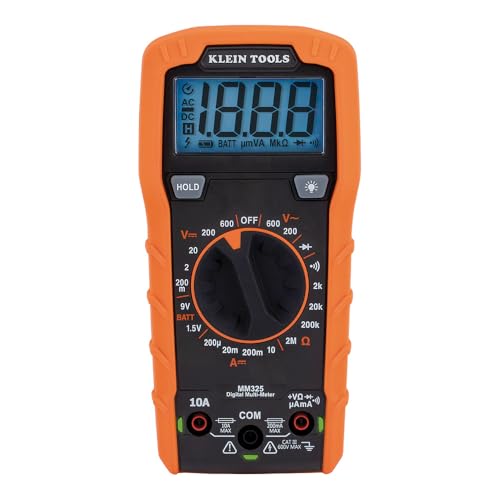


You’re not getting any fancy stuff, but you’ll comforted by the full assurance that it’s going to work reliably and accurately for a very long time. If even the cheapest in Fluke’s stable is beyond your budget limitations, I’ve mentioned some more reasonably-priced alternatives in the article.
The good news is that there is plenty more to come. I’m going to get cracking on some multimeter user guides soon. By the time you read this, the link to these guides may well be here.
I’m going to follow that up with a comparative review of a couple of Fluke meters. There are so many and I don’t want over-complicate things. I’ll take a little time researching your options and, hopefully, come up with a selection of Fluke multimeters that will float anyone’s boat. I’m sure we’ll be doing a few more multimeter reviews in time, keep checking this site. There’s plenty more to come.
Got questions? Drop them in the comments section below — I’d love to help!

