


I remember setting out to buy my first multimeter. I know for most folks it is not such a momentous event as it was for me at age 19. For me, as a young technician, excited to learn all there is to know about electrics and electronics, a DMM was like a passport to a whole new world. A real voyage of discovery.
I’m sure you’re not embarking on this mission with the same exuberance, but it’s still a pretty cool process once you begin. I’m quite amazed at what the engineers, developing products for the top brands, have come with.
I’ve been advised by my editor, very wisely, to consider various types of users. Consider what you would want to use an MM for and which would be the best for your needs. It wouldn’t be correct to place everyone into a box to be told: okay this is what you’re going to do and you will never deviate. So, I’ve needed to come with a thoughtfully comprehensive approach.
I have, with some great guidance, come up with a bunch of multimeter uses. Whether you’re a pro or a novice, you should be able to scroll down the page and take a look at all the possibilities. Then make a more informed decision as to which way to turn.
“I’m going to start out with advice that I believe is invaluable for newbies to electrical testing, professional or not,… think about the future when you buy today.”
If you’re a curious cat, you have my respect as a fellow adventurer. Moreover, you should always keep in mind that you’re going to be discovering new devices and gadgets through the passage of time. You’ll inevitably want to know more with each new discovery. The multimeter that suits your needs today, may be hopelessly insufficient a couple of years down the line.
Alternatively, if you really don’t have much interest in electricity beyond its utilitarian value, you have no need for anything too fancy. I guess most people would want to test batteries, check electric outlets, and perform some basic home electrical safety checks.
Others may be into auto electrics, which is something I’ve followed with great admiration and fascination since the 1980s when, as a high school kid, I first started tinkering with cars. Things have come a long way since then. Modern cars are a treasure chest of electrical engineering wonders.
I’ll offer some user guide articles, at a later date, which should be a great help. However, I will, in this multimeter buying guide, allude to what you’ll need to buy for the tasks you want to accomplish, and future possibilities if you’re smart.
What Does a Multimeter Measure?
As we progress from here on, I’ll be referring to a number of multimeter functions and features which seem quite self-explanatory to those who know and understand these tools, but can be somewhat bewildering for others who are not seasoned users.
Most multimeters have a dial that you turn to select the most common features and a few buttons that you press for other functions. At its core, a digital multimeter is designed to measure four fundamental electrical properties that form the foundation of electrical troubleshooting.
-
Voltage (measured in volts) is the first and most commonly used function, allowing you to check how much electrical potential exists between two points in both AC (alternating current) and DC (direct current) forms whether it’s testing a car battery’s 12 volts, verifying a household outlet’s 120 volts, or checking if a 9-volt battery is still good.
-
Current (measured in amperes) tells you how much electricity is actually flowing through a circuit, which is essential for diagnosing if a device is drawing too much power or if there’s a short circuit.
-
Resistance (measured in ohms) reveals how much a component or wire opposes the flow of electricity – perfect for testing if a heating element has burned out, checking the integrity of a wire, or verifying resistor values in electronics projects.
-
Most basic multimeters also include a continuity test function that emits an audible beep when a circuit is closed. In other words, when there is a constant, unbroken electrical current. Making it incredibly useful for quickly checking if wires are broken, fuses are blown, or switches are functioning properly.
Beyond the basics, higher-end multimeters often include specialized features. Here’s where multimeters start to differentiate themselves. Depending on your needs, these additional features can range from essential to completely unnecessary.
- Diode tester
- Capacitance tester
- Transistor tester
- Frequency meter
- Millivolt meter
- Milliamp meter
- Temperature meter
- Humidity meter
- Screen backlight
- LED flashlight
- Hold – to lock information onto the screen
- Maximum, minimum and average readings
- Data logging
- Graphic data displays
Multimeters for Home Use
Considering the myriad of home user requirements for electrical measuring equipment, it has taken a fair amount of deliberation to figure out on how to present you with solutions.
It’s easy to advise the pros because I have a good understanding of the challenges encountered in various professional environments. However, home users are as varied as it gets. We all have our priorities and perhaps some hobbies that may require a bit of electronic skill. As a result, I’ll be using a few subheadings in an attempt to try keep things reasonably organized and uncomplicated.
While Fluke is always my first choice, I think many home users will get better value from one of the cheaper brands. Fluke is brilliant for pros, whereas many of the other brands have tried to make things easier, simpler, and cheaper for guys who don’t possess years of experience and training.
In the end, do you really care if you get a reading 120.5V instead of 120.362V? For the average guy: 120-ish volts is perfectly fine, it means you’ve got power and that’s okay. For detailed electronic measurements, a difference of 0.05V can be mission-critical. If you don’t need that level of accuracy why spend a small fortune when that money could be put to better uses? I’m sure you would prefer to spend your cash on the important stuff, like beer and burgers 🙂
The good news for the many who aren’t interested in high-tech details, there are an absolute plethora of great options. Some of them pretty cheap too.
“I’ll have to include my old adage that regular readers of this site may have grown weary of hearing, but it’s important all the same, so I’ll reiterate: buying too cheap is outright crazy.”
Be realistic, conduct detailed research, or let guys like me do it for you. Certain brands have a longstanding reputation for good quality at reasonable prices. For home users it is imperative to make this distinction.
Money can be needlessly wasted on high-end expensive products that are way beyond the scope of your needs. Conversely, and equally poignant, you can waste money buying cheap junk that ends up in the trash the day the warranty expires.
As a result, I’ve put in hours of research into products that I wouldn’t necessarily buy for myself because I have other requirements, yet feel perfectly confident recommending to another who does not require the same level of expensive sophistication. In this instance, it would be electric measuring and testing equipment for people who have no real professional interest. You just want something reliable that will do the stuff you want it to.
Enough chit-chat – time to get onto the serious stuff. What will you typically want a multimeter for and what are your best options?
Testing Batteries
Testing batteries has become hot news these days. There’s an ever-increasing horde of battery-powered devices entering the market each day. Cordless is the new cool. This also means we have so many batteries of varying voltages and complexity in our homes, shops, and garages.
Understandably, most people aren’t interested in all the technical details, you just want your equipment to work and a functional battery is essential for this.
If you’re looking for a device to test all your different batteries without any skill or complications, I found a wonderful device whilst searching the internet warren of endless possibilities. I have to come out with full disclosure here. I would not buy this product. I have no need, I have one of the best multimeters you can get and have all the experience one needs for such a sophisticated work of electrical genius.
If you’d prefer the easier route, listen up. This is purely a battery testing device, not a multimeter. It’s also an analog battery tester, which appeals to my old-school sensibilities. Above all, it tests all types of batteries and it’s as easy as pie to understand. I think even my mom, who was about as impractical about these things as it gets, would have been able to handle this tester with ease.
I can recommend, without a hint of reservation, the Gardner Bender GBT-500A battery tester as a pretty cheap (but certainly not nasty) battery tester. Keep in mind that this device only tests batteries and does not perform multiple tasks for which the multimeter is aptly named.
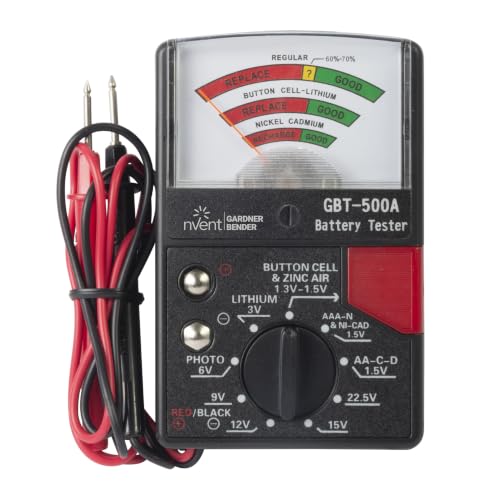

When testing batteries, it’s not just about the volts. It’s important to know actual battery strength. Is it still holding charge for long enough? Of course, it’s easy to notice when a device isn’t operating for as long as it should before we run out of juice. We can’t always be certain of the cause and it isn’t always a good idea to assume that a battery needs to be replaced before testing it thoroughly.
Now I’m sure few reading this want to come to grips with internal resistance and all the other stuff that are crucial to understanding how batteries work. A good quality battery tester will do the job for you.
Outlet Testing
This is a common conundrum that we all encounter and even the most basic multimeters are set up to do this. It’s simply a matter of setting the DMM to the correct AC voltage range and inserting the corresponding probes into the outlet – black for neutral and red for hot (live).
There is a slight risk when testing an electrical socket this way. The conductive section of the probes can be exposed whilst electrical current is passing through them. To eliminate this danger, some DMM manufacturers have developed dedicated outlet testers.
General Household Electrical Repairs
Here is where the waters become a little murky as we are not all as brave, crazy, or perhaps knowledgeable as one should be when checking and fiddling with electrical appliances. If things go wrong… Well… You could end up with an explosive situation.
Having cautioned you, I will say it can be great fun, very rewarding, and cool to brag about when you do get it right. I’ll list a few typical situations where you could shine if you have the right multimeter and know how to use it. I’ll mention what multimeter function to use when testing appliances and circuits so you know what to look for when comparing DMM models.
Testing Light Switches
Lights are not too difficult to maintain and repair. When a light stops working and darkness descends upon your life, your first recourse is to check the globe. If this is fine one may assume a great and expensive problem has hit.
Quite often, the switch can be problematic which is easy enough to diagnose using the continuity tester on your multimeter to determine if the switch is closing when in the on position.
Testing Circuit Breakers
If a circuit breaker seems dodgy, you can test continuity when the switch is in the on position. It is good practice to perform periodic load tests for each circuit. An ammeter, if your multimeter has this function, can be connected in series along any circuit to measure how many amps of current is being used.
The amperage of a circuit should always be less than the amp rating for the breaker supplying that circuit. If the breaker does not trip when the amperage exceeds its rated amperage, it poses a fire risk. Modern breakers are very reliable, but it is prudent to check these things from time to time.
Testing Resistance Heaters
One of the first uses of electricity, after lighting, was heating equipment. Traditionally resistance heaters were the standard for water and space heating equipment. Despite the advent of heat pumps and induction heating, resistance heaters remain very popular.
Testing resistance heaters requires two multimeter functions. First off, you’ll want to check continuity to establish if the circuit has been broken. If this is okay, a resistance test will determine if the unit is not damaged.
Low Voltage Systems
The modern home can have any number of low-voltage electrical systems, from doorbells to alarms. Some of these may be DC, supplied by a battery or transformer, but can also use a low-volt AC current in some instances.
By trying out the different voltage settings on your multimeter, you can establish the type of current and voltage by toggling through the settings until you get a whole number reading. You can’t damage a multimeter by attempting to measure AC on the DC setting or selecting the wrong voltage range, so toggle away with reckless abandon.
You will need to select a range that is closest to and higher than the expected reading. For example: if your multimeter has DC voltage ranges indicated at 20V; 50V; 100V and you want to measure 12V – you’ll select the 20V setting. If you select a higher voltage range, you may get a reading of 1V or a decimal less than 1V. When this happens turn the dial to a lower range until you get a whole number reading with the possibility of decimals if the meter has that level of accuracy.
Testing these systems may require a number of MM functions. Voltage to ensure that the supply current is correct. Continuity testing will assure that the circuit has not been broken, and you may need to test resistance and, possibly diodes on some resistance and electronic components.
HVAC Systems
Air conditioners, furnaces, and HVAC systems require regular maintenance and safety checks. Electric motors for compressors will need several tests when diagnosing faults. Continuity and resistance tests will ascertain if the stators or rotor are in good working order. A capacitance tester will eliminate any doubts regarding the capacitor.
Electronic components, like digital thermostats and control panels can be a little trickier for the novice. These could require continuity testing, resistance measurements, as well as transistor and, sometimes, diode testing.
What is The Best Multimeter For Home Use?
Just for the fun of it, I typed this question into the Google search bar to see what comes up. The AI answer got it horribly wrong, in my opinion. Sorry Gemini, but you just didn’t put any real thought into the question.
My analysis, based on several decades of real human experience is as follows:
The best, reasonably affordable DMM for basic pro and home applications would be the Fluke 101. No surprise there. It’s my personal top multimeter brand. The 101, being the entry-level model is not too expensive, easy to use, and reliable. It sort of ticks all the boxes for the home user. Although, some may prefer something a little cheaper.

Now for the real whopper. If I put my brand bias aside, ignoring my affinitive attraction to Fluke, I’ll have to admit that Klein Tools offers the best value DMM for DIY with their MM325. It’s a wonderful, dare I say remarkable, all-rounder.
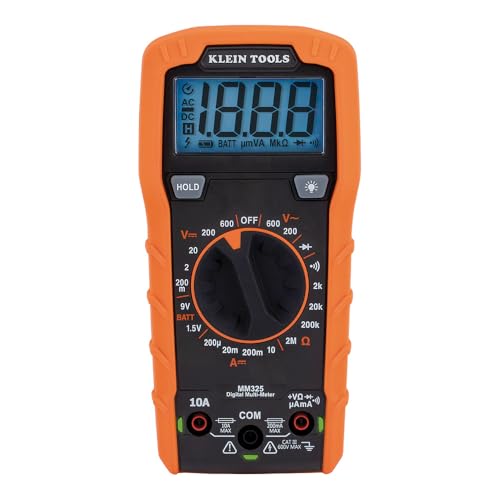
It’s got everything you need, including a built-in 1.5V and 9V battery tester. Best of all, the price is way more attractive than the Fluke 101. Comparing the two prices, I think most folks would gravitate toward the Klein Tools model.
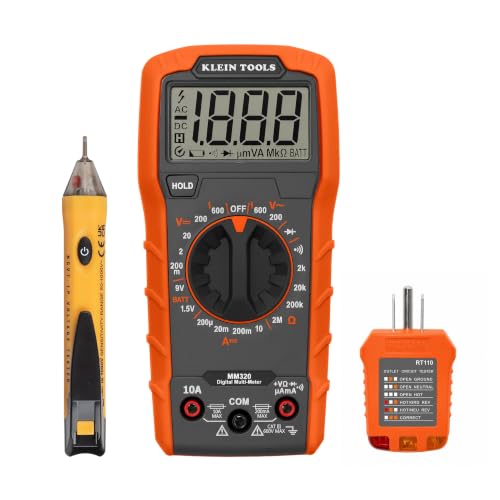
Another truly superb all-rounder multimeter for the home has to be the Klein Tools 69149P electrical test kit. The kit includes a handy outlet tester that you merely have to plug into an outlet safely and easily. It effortlessly tests all outlet functions and safety requirements.
I’m going to go out on a limb here and add the DM130B from AstroAI to the best DIY multimeter list. Call me a cynic, but a good MM, with great functionality at a little more than $20 seems a little too good to be true. As a counterweight to this argument, 4.6 stars out of over 8,000 Amazon reviews isn’t half bad.

I’m a little on the fence about AstroAI multimeters, they have an enormous range, including a few with battery testers. As I have little to no knowledge of the brand, I’m skeptical. The prices seem almost too good to be true, which always rings alarm bells with me.
I’m unable to find any credible information about the company which, as an intrepid internet researcher, is a matter of even greater concern – are these things made in some factory in the remotest part of outer Mongolia with no way of tracing them when we need tech support?
I must, however, be fair and objective. I’ve seen plenty glowingly good reviews about AstroAI products. Notwithstanding that online reviews are not always that reliable. There are enough of them, though, to give me the assurance that AstroAI should, in the not too distant future, become recognized as one of the more respected brands in the business.
I’ve seen this movie before, you only have to look at the meteoric rise of brands like Honda and Toyota that started out as bargain basement cheap junk in the 1970s. Or that was what people assumed initially. They are now amongst the most revered and respected brands in the world.
That being said, at current prices, I’m willing to take a chance on AstroAI equipment. It seems millions have, and are extremely happy. You can be the judge on how you’d prefer to spend your 20 bucks and a bit.
Auto Electrics
I can get a bit over-enthusiastic about auto electrical work. Some of my best days have been spent pulling wires through old cars… and some of my toughest. It’s a wonderful thing, rewiring a car, but only if you strip it down and replace every wire. If you do this in an orderly way, it’s tremendously gratifying. So I’ll do my best to keep things brief and to the point.
For general auto electrical testing, a fairly basic MM to measure DC voltage in the 12V range and continuity testing is pretty much all you need. A 12V automotive test light is a very handy item too to keep in your car at all times. They’re inexpensive and there is a great selection out there.
When you start on more advanced testing, particularly sensors and ignition systems, a multimeter capable of measuring AC and DC millivolts is imperative. Alternators may also require diode testing.
Car Battery Testing
A good 12V battery tester is handy, otherwise every multimeter has a DC volt testing function with a range to include 12VDC measurements. The advantage of using a car battery tester, instead of a multimeter is that it will perform detailed load testing.
Along my search for battery testing equipment, I found a really cool car battery tester. It’s also great for deep cycle batteries, like those used for RVs, boats, and golf carts. It’s perfect for all 12V batteries and series 24V battery setups.
Unlike the Gardner Bender GBT-500A that I mentioned earlier, it doesn’t test smaller batteries. It is, however, the most comprehensive 12V/24V battery I’ve found in a price range that should be easily acceptable for most of us. It’s the TOPDON BT-200 car battery tester.

I know this is a battery tester, not multimeter. Truthfully, not all DMMs include battery testers, certainly not as easy to use as the two I’ve mentioned. You can use a multimeter to a rudimentary discharge load test with a little help from a friend.
You can have someone to honk the horn and switch items on and off, like the lights, wipers, and fan. By observing the change in voltage during these procedures, you can form a relatively accurate opinion on the health of your car battery.
Fuse Inspection
The easiest and most effective way of testing fuses is by means of a continuity test across the fuse. You don’t need to remove the fuse as they have too small holes which allow for a multimeter probe to be inserted for testing.
Alternator Testing
A basic alternator test involves simply checking the output voltage when the engine is running, using a multimeter set to VDC in the range that is closest to 14.5V which is the ideal alternator voltage.
For more advanced testing, you may want to test the rectifier, which will require a multimeter with a diode tester. Most Fluke models, from 107 upwards have dedicated diode testing functions. The same goes for Klein Tools.
Sensor Testing
It’s always best to start with an Onboard Diagnostic (OBD) test to find sensor faults. Once the problematic sensor has been identified, you can use a multimeter to test continuity, resistance, and voltage to diagnose the fault.
Damaged or Broken Circuits
Vehicle wiring can be subjected to some pretty harsh treatment causing damage to wires and switches. You can use a test lamp anywhere along a circuit to ascertain if there is a working current or not. Alternatively, a continuity test will establish if a wire is conducting electricity. It will also determine whether a switch or relay is closing correctly.
Ignition System
Checking sparkplugs is best done using a sparkplug tester, this is not a multimeter function. You could also do things the old-fashioned way by grounding the plug to the engine, cranking the engine and observing if the plug is sparking.
You can use your multimeter to test resistance of the ignition coil, DC voltage at the ignition control module, AC voltage at the crankshaft position sensor – this requires a millivolt (MV) setting.
What is The Best Multimeter For Auto Electrics?
For the whole hog in auto electrical testing equipment, there can be no better offering than the Fluke 88V automotive multimeter. It’s pricy, but wow! It’s magnificent. If you’re wild about auto electrics and want to indulge your passion, this would be a great treat.

Electronics
This could end up being an even longer discussion, but I think it’s prudent to keep it brief. If you’re going to delve into the fascinating world of transistors, resistors, and circuit boards, you will need to gain a lot of specialized knowledge to get going.
Although, it’s not too difficult to pick out the best multimeter for these tasks. Even if you don’t have all the experience of a pro. The knowledge comes with time, you’ll need a good DMM to get there.
Most electronic tests involve resistance (ohm) measurements. An accurate ohmmeter function with a good range and, preferably at least two decimal points lower than 1 is essential. Voltage ranges need to be more comprehensive with an AC millivolt testing function.
I often find myself doing detailed continuity testing along circuit boards. Since continuity testers are pretty much standard on all multimeters, there’s no need to dwell too much on this topic.
Choosing the best multimeter for electronics will be a very personalized decision as requirements vary greatly. Most of the top Fluke and Klein Tools multimeters have all the functionality that is required for specialized and amateur electronic testing.
Professional and Industrial Applications
Here again, I’m not going to go into too much detail, simply because professional electricians, technicians, and engineers can be very specialized and you know pretty much what you need. For those embarking on these professions, I may be able to shed a little light on what you should be looking for.
I have used multimeters professionally for many years but it’s impossible for any one person to keep up with every new innovation that has happened in the electrical measuring equipment industry. It’s astounding the amount of amazing DMMs there are for any profession that has a need for these devices. If I were to share them all in this article it would be even longer than it already is. I’ve had to reign myself in and try focus on the basics.
Multimeter for Electricians
Electricians need to be a jack-of-all-trades in the realm of electrical repairs and installation. Most sparkies have some degree of specialization depending a lot, I guess, on the work they prefer.
Whether you gravitate more to industrial installation work, emergency electrical repairs, or any of the many jobs an electrician does, the general consensus is that the Fluke 117 is the best general purpose multimeter for electricians.

It has great ranges for both AC and DC voltages and is pretty accurate – voltage within 0.5%. Probably the coolest function for electricians would be non-contact voltage detection. The Klein Tools MM420 is also a quite popular model for general electrical work.

Multimeter for Industrial Engineers
The Fluke 289 is a real gem for engineers managing industrial plants. Its crowning glory is a really intelligent data logging feature with a wonderful digital display. Naturally, it also has the expected MM features too.

The Fluke 87V is also a winner in this field, designed for quick and easy fault finding on plant automation equipment, motor drives, and power distribution. It’s also super rugged.

The Hioki DT4282 also deserves a mention here. Although it’s not a brand I’m too familiar with, Hioki testing equipment has a stellar reputation and this model, in particular, has blown me away for incredible accuracy and comprehensive features.
Multimeter for Electronics Technicians
I know the work of an electronics technician is as varied as all the devices we use in our homes and businesses. There’s one particular DMM that I’ve seen in a couple of electronics shops that has impressed me immensely.

Possibly because it looks so cool and intriguing. This would be the Fluke 8808A digital bench multimeter. It is stupendously accurate with a bunch of programmable buttons and amazing testing capabilities.
Multimeter for HVAC Technicians
Having a measuring device that has all the electrical measurement functions that a techie could want, as well as the ability to measure temperature and humidity, is possibly the HVAC technician’s dream machine. Once again, Fluke comes up tops in the form of the Fluke 116 – it’s pretty untouchable in this race.

Multimeters for Solar Technicians
Photovoltaics or solar electricity is something I have had a lot of experience with. As a result, I have become the proud owner of a Fluke 283, even though this model was only introduced once I was no longer that active in the PV industry.

I have to say unequivocally that I absolutely love this thing. It is a superb piece of engineering and capable doing much more than assisting technicians in the renewable energy industries, it’s a great allrounder with a few special traits tweaked for the renewable energy sector.
I say renewable energy because it is equally capable for wind and mini-hydroelectric power generation. This is because it can measure unusually high DC voltage up to 1,500VDC and DC amperage up to 60A. Both these functions are really important when working with high-amp, high-volt DC generation systems. Like those we deal with all the time in the renewable electricity business.
In Conclusion
Wading through the labyrinth of multimeter specs on countless websites can leave one a little weary and, possibly, more confused than you were at the outset. I hope I’ve shouldered some of that burden for you. I’ve enjoyed the process.
When it comes to choosing a DMM, my not-too-objective opinion is to start with what Fluke has to offer and then work your way down the price range if your budget can’t reach the highest shelf of excellence.
I’ve tried to narrow your search down to a few of the best brands. Take a little time to consider these options and, perhaps, some others that the web may present to you. It’s good common sense to stick to established brands, with a reputation for dependability, when buying anything and this rings just as true when setting out to find the best multimeter.
The race seems to be mostly between Fluke (the best of the best) and Klein Tools in a perfectly reasonable second spot with prices that are less daunting. A few other great brands have also featured with some of their nicely specialized models. Now it’s time for you to head out with confidence and enjoy buying the multimeter that’s best for you.
Got questions? Drop them in the comments section below — I’d love to help!

