


As we head into fall, it’s time to put away the gas can and embrace the power, convenience, and eco-friendliness of a battery-powered leaf blower. One of the leading brands in this category is STIHL, a trusted name in outdoor power equipment.
STIHL offers an impressive lineup of cordless leaf blowers, ranging from lightweight, compact handheld models perfect for quick clean-ups to powerful, high-performance backpack models for tackling those more challenging jobs and larger properties.
Let’s take a closer look at some top-rated STIHL battery leaf blowers on the market today, highlighting their cutting-edge features and impressive performance.
Why STIHL?
There are dozens of great manufacturers that design and build high-quality leaf blowers. But we’ve always been a big fan of STIHL power tools in general.
While the brand is perhaps more associated with the professional sector thanks to their reputation as a premium brand, they also offer several models that are perfect for the types of jobs a homeowner would typically expect to carry out.
And while the price is considerably higher when compared to other manufacturers on the market, the quality, power, and reliability more than makes up for it.
Handheld or Backpack?
If you’re new to leaf blowers, you might not have been aware that they could come as handhelds or designed for backpack use. But is one form better than the other? In general, the higher you move up in terms of specs, the more likely it is that you will only have access to backpack models.
The reason for this is obvious – more powerful leaf blowers require larger, heavier batteries to deliver the necessary power. Consequently, the batteries used in high-performance models can add significant weight to the unit. You’d need a lot of strength and endurance to lug STIHL’s BRA 600 around as a handheld.
So choosing between a backpack or handheld blower largely comes down to the size of the area and type of debris to clear, your personal comfort preferences and budget of course. For most homeowners with typical yard or driveway clearing jobs, a handheld is enough to manage the job.
However, for most professionals or homeowners faced with more challenging clearing tasks a backpack leaf blower is often the preferred choice. These powerful machines offer superior performance and runtime compared to handheld models, making them better suited for tackling expansive properties, thick layers of leaves, or heavy, moisture-laden debris.
Key Features to Consider
Investing in a battery power tool can be a significant expense for most homeowners, especially when considering the additional cost of one or more batteries including charger on top of the bare tool itself. So let’s get it right first time and be aware of the types of things you should be looking out for when choosing your leaf blower.
Battery Specs (Voltage and Runtime)
- Voltage (V) – Voltage refers to the power output of the battery. Higher voltage generally means more power and better performance. Common voltages for battery-powered leaf blowers range from 18V up to 80V. Higher voltage blowers typically deliver stronger airflow and can handle tougher debris. But that’s only half of the story. A 40V leaf blower can outperform a 60V model if it draws more amps from the battery.
- Runtime (Ah) – Runtime measures the battery’s capacity or the amount of energy it can supply before it needs to be recharged. A higher Ah rating usually translates to longer runtime on a single charge. For example, a 5.0 Ah battery can supply 5 amperes of current continuously for 1 hour and will typically run longer than a 2.5 Ah battery at the same voltage.
- Battery compatibility – If you already own other battery-powered power tools from the same brand, consider choosing a leaf blower that uses the same battery platform. This allows you to interchange batteries and save money on additional purchases.
Blower Specs (CFM, MPH and Newton)
There are a couple of other key metrics that you should look out for to determine the overall performance of a leaf blower.
- CFM (Cubic Feet per Minute) – CFM measures the volume of air that the leaf blower can move per minute. A higher CFM indicates that the blower can move more air, making it more efficient at clearing leaves and debris. For most residential use, 400 CFM up to 500 CFM is sufficient. However, for larger properties or more challenging jobs, you may want to consider a blower with a higher CFM.
- MPH (Miles Per Hour) – MPH refers to the speed at which the air exits the blower’s nozzle. A higher MPH means that the blower can help move debris quickly across a larger distance. Most blowers that are suitable for home use will be in the range of between 120-180 MPH while a 200+ MPH rating is considered to be on the upper end and is usually reserved for commercial models.
- Newton (N) – Newton measures the force of the airflow. A higher Newton rating indicates that the blower can produce a more powerful and forceful airstream, which is particularly useful for moving heavier debris or wet leaves. For residential use, leaf blowers typically have a Newton rating in the 10 N up to 20 N range. If you frequently deal with heavy or wet debris, consider a blower with a higher Newton rating.
Still confused about CFM, MPH and Newton?
Let’s imagine you’re watering your garden with a hose. CFM is like the volume of water flowing through your hose. If you have a wide hose, more water can flow through it at once, even if the speed of the water remains the same.
MPH is like the speed at which the water is coming out of the hose. A higher MPH means the water is moving faster, which can help you reach farther distances. Newton, on the other hand, represents the force of the water. A higher Newton rating means the water has more “pushing power” which can be useful for tasks like removing stubborn dirt or debris.
Now, let’s apply this to leaf blowers. A leaf blower with a high CFM can move a larger volume of air, which is great for efficiently clearing large areas of leaves and debris. However, just like a wide hose with slow-moving water, a high CFM alone may not be enough to dislodge stubborn or wet debris.
This is where MPH and Newton come into play. A leaf blower with a high MPH can help move debris quickly across a larger distance, while a blower with a high Newton rating can provide the necessary “pushing power” to remove heavier or stuck-on debris.
So to wrap it up, consider CFM for the volume of air moved, MPH for the speed and Newton for the force of the airflow. By understanding how these factors work together, you can select a leaf blower that best suits your needs.
- If you have a large yard with lots of dry leaves and debris, a blower with a high CFM and decent MPH rating may be sufficient.
- If you often need to clear wet, damp leaves or stubborn debris, a blower with a high Newton and MPH rating will be more effective.
- For general-purpose leaf blowing, look for a balance of CFM, MPH, and Newton that can handle a variety of tasks efficiently.
It’s important to note that while higher CFM, MPH, and Newton specs generally indicate better performance, they also often come with trade-offs such as shorter runtime, higher noise levels, and increased weight, to name just a few. By carefully considering these trade-offs and prioritizing the features that matter most to you, you’ll be able to select a leaf blower that offers the optimal combination of performance, convenience, and value for your unique situation.
Ergonomics and Comfort
You’ll want to be sure that you’re comfortable as you use your tool, particularly for longer stints. Take a look at the weight of the tool (both with and without the battery) and make sure it’s something you can handle.
Features such as rubberized grips and anti-vibration systems are also desirable if you want a smooth experience when using your tool for long periods. Also keep an eye out for the rated noise level, particularly if you live in a heavily urbanized area.
Special Features
Most leaf blowers only do the one job, and so fundamentally, they’re all going to be quite similar. However, some brands are more innovative with their additional features than others.
Things such as variable speed and boost modes, variations in nozzle types, anti-vibration and noise reduction technolgy are all excellent additional perks that can separate one tool from another.
Brand Support
Unfortunately, power tools are prone to breaking down now and again. When this occurs, you’re going to want a brand that has a good level of customer support and warranty periods, as well as a high number of nearby suppliers where you can bring your tool in for repair or shop for spare parts.
Some brands only work with industry-specific suppliers rather than making their tools available on more general online marketplaces such as Amazon. STIHL is such a brand.
By partnering with dedicated online specialty suppliers – like Acme Tools for example – and offering a fantastic network of suppliers across the country, STIHL ensures that their customers have access to knowledgeable staff and genuine parts, making it easier to maintain and repair their tools when needed.
STIHL Battery Leaf Blowers – The Contenders
Now that we’ve discussed what you need to consider, it’s time to take a look at some of STIHL’s best-rated battery leaf blowers. We’ll start with some lower-end models in terms of budget and performance before moving up to some of the higher-tier models that are best suited for heavy-duty clearing tasks.
STIHL BGA 60 (Handheld)
We’ll start with the lightest model on our list – the BGA 60 handheld. Despite its relatively small size and weight (5 lbs without the battery – 7.9 lbs with battery included) compared to others we’ll be covering, it’s still a highly efficient tool and one that should be considered if you need something for light yard work.
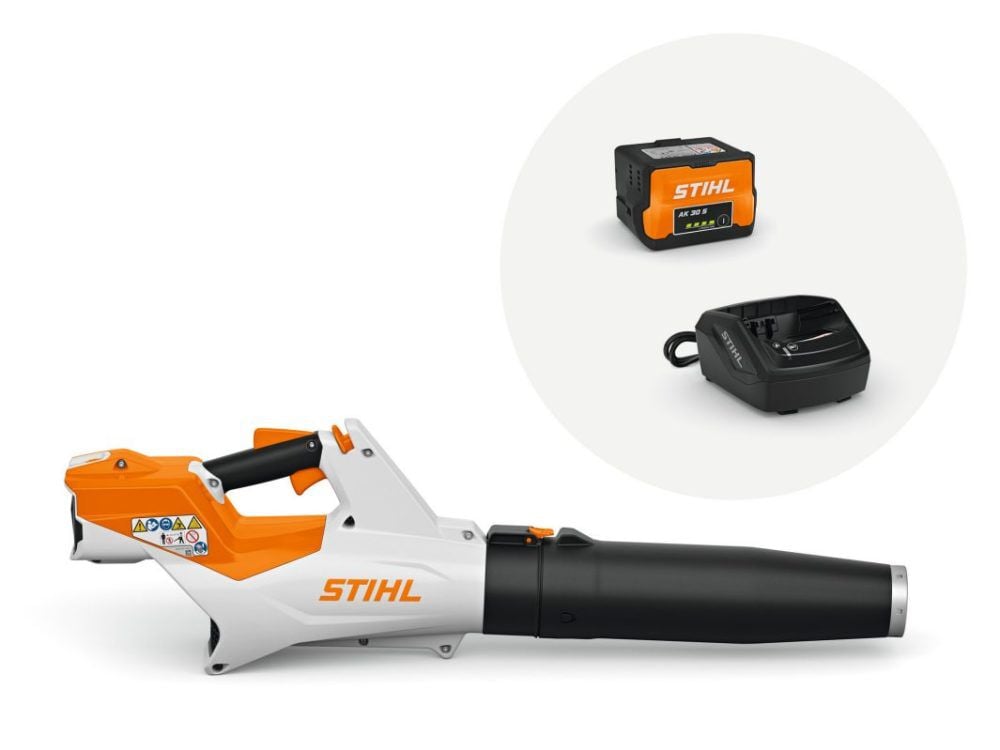
STIHL BGA 60 (including Battery + Charger)

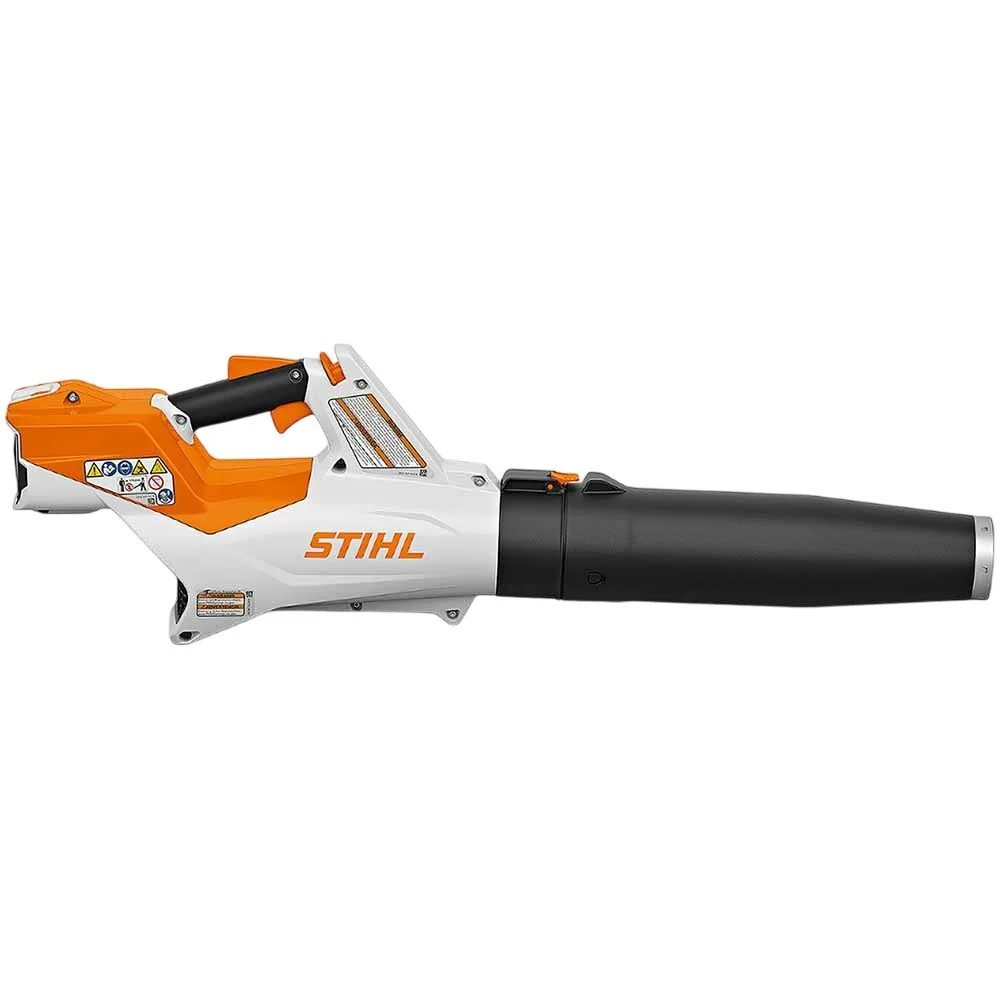
With a maximum air velocity of 154 MPH, air volume of 459 CFM and up to 15 Newton blowing force it lands right in the middle of the range that we would expect to see for a standard home use blower with these dimensions.
The tool is very easy to set up and assemble, with a click-on system to attach the battery and a nozzle that can easily be slipped on to the tip of the blower. The BGA 60 is also noted for being reasonably quiet (56 db(A)) for the amount of power it generates. And with variable speed settings and a power boost mode to get through those trickier piles, it’s more than enough for most homeowners.
A minor complaint is the relatively short runtime on a single charge. The BGA 60 is using STIHL’s AK Battery System which offers three different 36V battery options: the AK 10 (2.0 Ah), AK 20 (4.0 Ah), and AK 30 (5.0 Ah).
Depending on the battery you use, the runtime can vary significantly. With the smallest battery, the AK 10, you can expect a runtime of approximately 9 minutes. Upgrading to the AK 20 will provide a slightly longer runtime, while the most powerful battery AK 30 (our recommended choice) offers a rated runtime of up to 16 minutes.
Actual results may vary depending on factors such as the blower’s power setting and the type of debris being cleared. If you have a larger property or extensive clearing needs, you might find yourself needing to pause and recharge the battery often before you can finish the job. In that case it may be useful to invest in additional spare batteries to minimize downtime or consider a blower with a longer runtime like the BGA 86 we’ll discuss next.
STIHL BGA 86 (Handheld)
Next in line: STIHL’s BGA 86. This handheld comes with the same maximum CFM (459), MPH (154) and Newton (15) ratings as the BGA 60 but it uses STIHL’s more powerful AP range of batteries. That clarifies the small step up from the BGA 60 in terms of weight (6.2 lbs without the battery – 10.2 lbs with battery included).

STIHL BGA 86 (including Battery & Charger Kit)
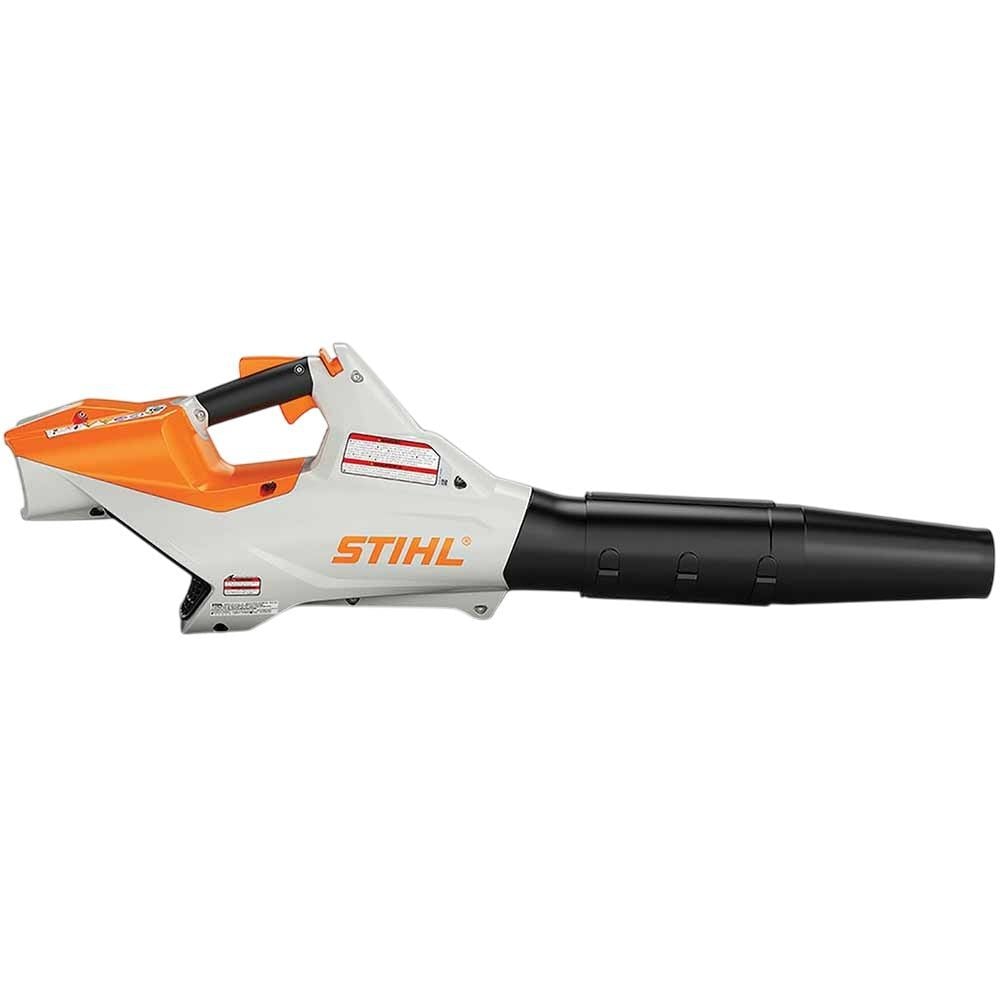

The recommended AP battery providing the best balance, adequate runtime, and optimal performance is the AP 300 S (36V -7.2 Ah) battery with a rated runtime of up to 26 minutes. That’s about ten minutes more runtime than the BGA 60 when paired with an AK 30 battery, making this blower better suited for tackling properties that require more time to clear.
STIHL BGA 100 (Handheld)
Let’s now take a look into some professional-grade models. The BGA 100 is the first blower on our list that does not come with a click-on battery system. Instead, users will either need to purchase the AR 3000 L battery backpack (20.9 lbs) or insert one of STIHL’s AP batteries – with the AP 500 S (36 V – 9.4 Ah) being the recommended choice – into a battery belt.
While this additional setup can be a little cumbersome for some users, it offers a significant advantage. By moving the battery weight from the blower to the user’s back or hip and connecting the battery with the tool via a high-performance cable, STIHL has managed to create one of the lightest commercial-grade handheld battery blowers in their lineup (5.5 lbs), making the BGA 100 an ideal choice for professionals who require a powerful yet comfortable tool for extended periods.

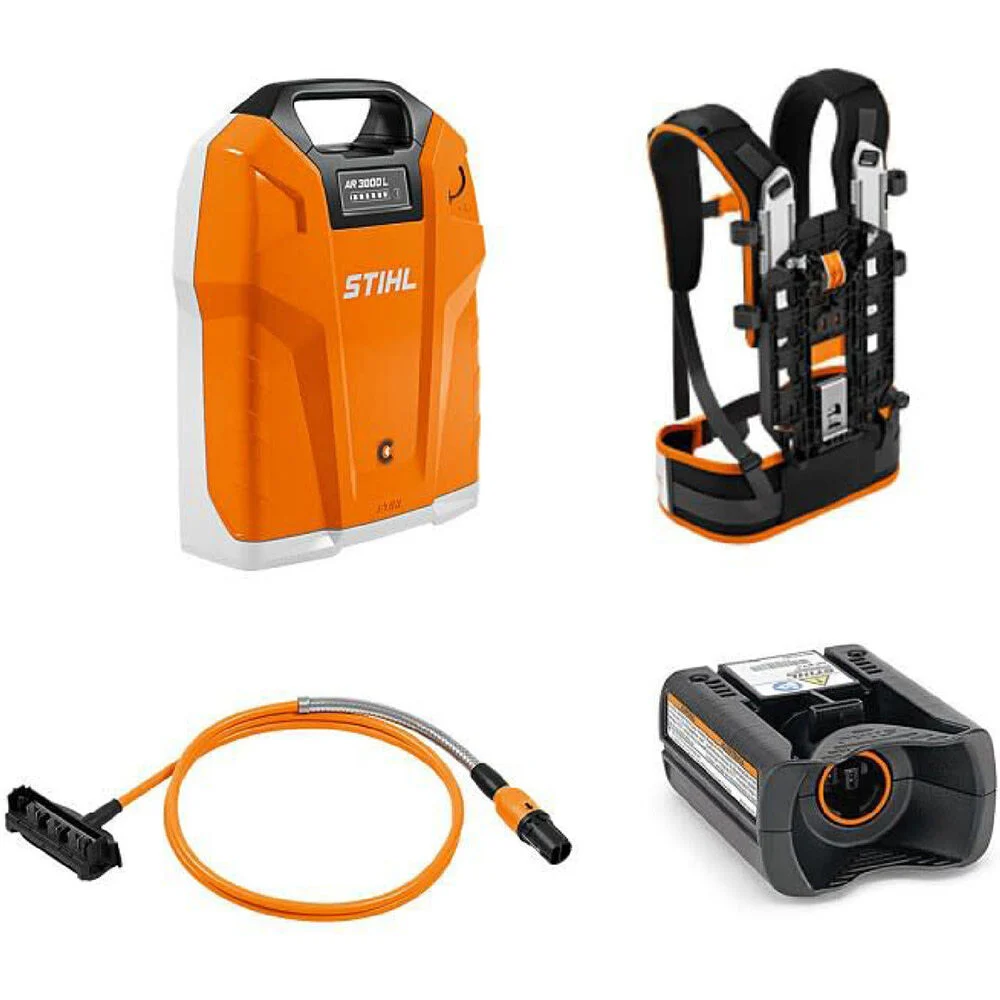

Battery backpack or battery belt? The latter provides a high degree of versatility, allowing you to choose the most suitable AP battery size based on your specific work requirements and the expected duration of your tasks.
On the other hand, for those exceptionally long and demanding clearing jobs, the 42.2 Ah battery backpack is the ultimate solution. With its impressive rated runtime of up to 510 minutes, this backpack provides an unparalleled power supply, enabling you to tackle even the most challenging tasks without interruption.
With a maximum air velocity of 168 MPH, an air volume rate of 494 CFM and up to 17 Newton blowing force, you’ll instantly notice the extra power when using this tool. This is made all the more impressive given the fact that it still achieves this using a 36V battery system.
If you need to purchase the entire kit from scratch, you are looking at quite an expensive initial outlay. But the BGA 100 offers all of the qualities and reliability you would expect from a STIHL power tool, making it a great choice and investment.
STIHL BGA 300 (Backpack)
Let’s move on with the first backpack blower on our list – the BGA 300 – another powerful and versatile battery leaf blower designed for professional use. Users can pair the blower with the AR 3000 L battery backpack for an impressive rated runtime of up to 140 minutes.


Another (less expensive) option is to choose for the ADA 1000 adapter, which can accommodate up to two STIHL AP batteries. When used with two AP 300 S batteries the BGA 300 gives you a rated runtime of up to 50 minutes.


This adaptability along with the four available speed settings ensure that professionals can tailor their power supply to match the specific requirements of each job, whether it demands extended runtime or maximum portability.
However, it’s important to note that the BGA 300 is a heavy-duty tool, and its weight reflects its robust construction and powerful performance. When equipped with the ADA 1000 adapter and two AP 300 S batteries, the blower weighs approximately 28.8 lbs, while the blower with AR 3000 L battery backpack tips the scales at around 37.9 lbs.
This substantial weight may not be suitable for everyone. You should be prepared for the physical demands of operating such a powerful piece of equipment. Luckily, the BGA 300 boasts a thoughtfully designed ergonomic system that includes STIHL’s anti-vibration system, a rubberized soft-touch handle, and an adjustable harness, all working together to reduce operator fatigue, enhance maneuverability, and provide a comfortable, extended working experience with minimal strain.
Despite the weight, the BGA 300’s jump in performance more than compensates. This blower is more than a match for most clearance tasks. The blower can generate a maximum air speed of up to 192 MPH, air volume of up to 571 CFM and a blowing force of up to 26 Newton, a massive jump from the BGA 100. This makes it an indispensable tool for professionals who demand the very best in outdoor power equipment.
A feature worth noting is STIHL’s innovative Noise Reduction System, which is designed to minimize noise emissions from the blower in all directions. This advanced technology ensures that the blower operates at a remarkably low noise level of just 62 decibels, making it an ideal choice for use in noise-sensitive areas such as residential neighborhoods, hospitals, schools, or parks.
STIHL BRA 600 (Backpack)
We end our overview with STIHL’s most powerful battery-powered backpack blower – the BRA 600. The tool comes with a built-in battery system that must hold two batteries from STIHL’s AP range.
For the longest working time (about 18 minutes) it’s recommended to pair the BRA 600 with two AP 500 S batteries. Combined they deliver an impressive 72V enabling the leaf blower to generate an astonishing blowing force of up to 35 Newton and a maximum air speed of up to 246 MPH.
This configuration results in a total unit weight of 32 lbs. While the backpack design helps distribute this weight evenly, users should still be mindful of the potential fatigue that may occur during prolonged use.

The BRA 600 comes with two interchangeable nozzles – a volume nozzle for tackling large quantities of dry debris and an air speed nozzle for dealing with wet and heavy debris. Depending on which nozzle is used, the rated maximum air volume is 253 CFM and 883 CFM, respectively. The nozzles, combined with the four available speed settings give users all the flexibility to adapt the blower to their specific requirements.
While the BRA 600 and BGA 300 share many similar features, one notable addition to the BRA 600 is the Deluxe HMI (Human-Machine Interface) Control. This advanced feature provides users with a convenient, easy-to-access display and control panel located right at their fingertips. It allows operators to monitor essential diagnostics, such as battery life, in real-time, or control various settings on the blower.
This user-friendly feature demonstrates STIHL’s commitment to designing tools that not only deliver exceptional performance but also prioritize user comfort and convenience, making the BRA 600 a top choice for professionals seeking a cutting-edge, efficient, and intuitive battery-powered backpack blower.
Final Thoughts
In conclusion, STIHL’s impressive lineup of battery-powered leaf blowers offers a compelling alternative to traditional gas-powered models. With a range of options suitable for both homeowners and professionals, STIHL has demonstrated its commitment to innovation, performance, and environmental sustainability.
For homeowners, the BGA 60 and BGA 86 provide efficient and user-friendly solutions for tackling everyday yard cleanup tasks. The BGA 60 is perfect for those with smaller yards and lighter debris, while the BGA 86, with its longer runtime and increased power, is ideal for larger properties and more challenging tasks.
Professional landscapers and contractors or homeowners with more demanding clearing needs have even more impressive options to choose from, with the BGA 100, BGA 300, and BRA 600, all boasting unrivaled power, comfort, and control.

